Demo site — want one for your business?

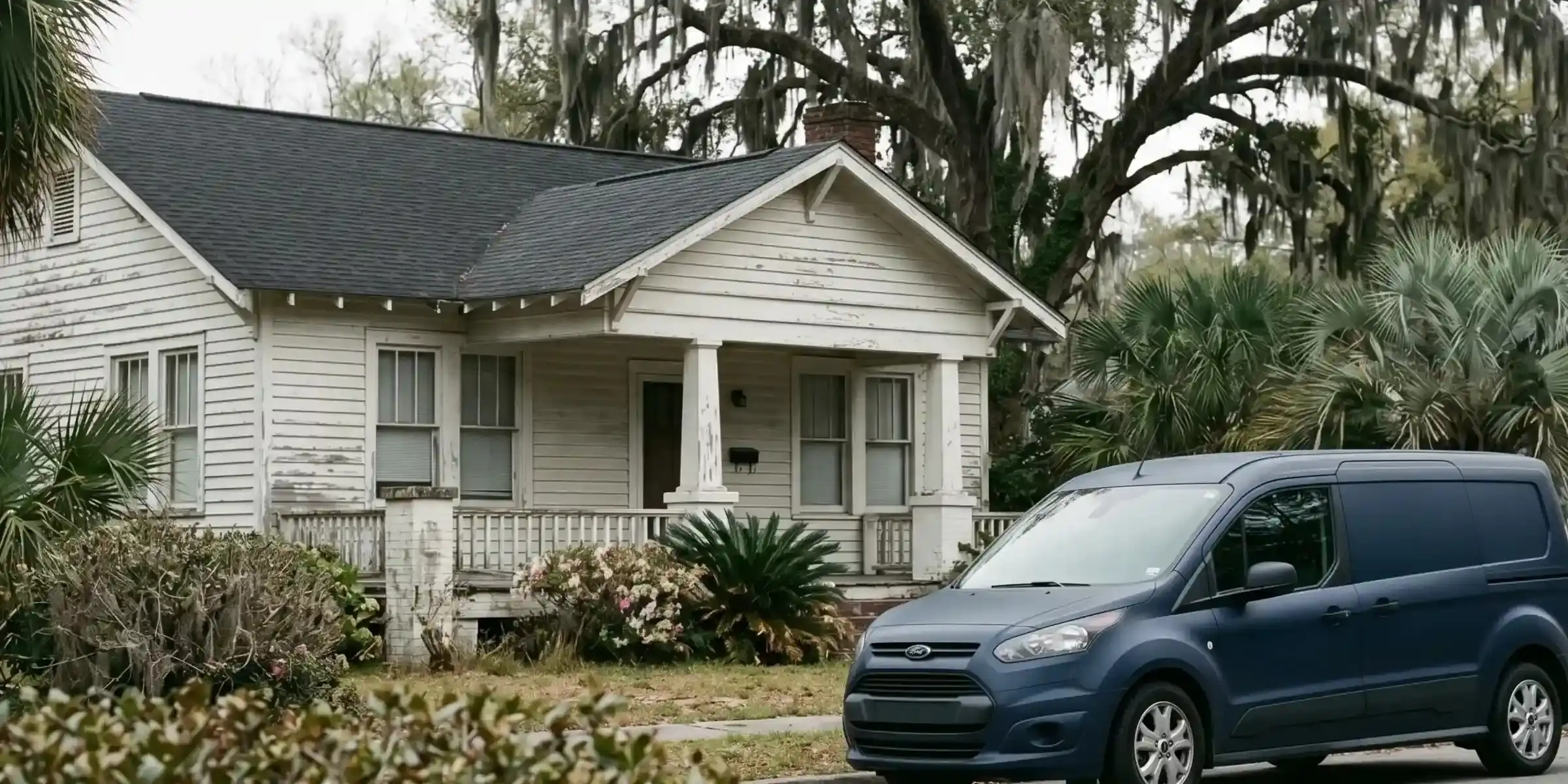
    Marshlight Transit Connect parked in front of a Charleston craftsman home in late-afternoon Lowcountry light
    Charleston Lowcountry · Residential pest control

    Quarterly residential pest control in Charleston, with monitoring data behind every treatment decision.

    Pricing is $135 flat for properties under 4,000 square feet, $165 above — published here, before any conversation begins. The first inspection is free. Service is month-to-month after the first quarter; cancellation is a phone call.

    QualityPro & GreenPro certified · M.S. Entomology, USC

    How Marshlight works

    Three commitments encoded in the operation.

    Treatment intensity is matched to what monitoring shows.

    Quarterly visits begin with monitoring before treatment. Technicians walk the property, identify pest pressure by zone, and treat only what the data warrants. A property that shows no ant pressure in February doesn't get ant treatment in February. A woodline showing carpenter ant activity in May gets treated for carpenter ants — using the formulation that targets the species, since carpenter ants and fire ants respond to different active ingredients.

    Some quarterly visits are inspection-and-monitoring with minimal treatment, and the price is the same for those visits. The inspection is the actual service; monitoring tells the technician what to do, and the visit produces a documented record either way. Chain protocols assign treatment by schedule. Marshlight's protocol assigns treatment by observed pressure. The structural difference shows up across a year as fewer pesticide applications on properties that don't need them, with the customer paying the same flat rate.

    Quarterly pricing published before any conversation.

    The flat quarterly rate is on this page: $135 for properties under 4,000 square feet, $165 above. Termite inspection is $185 annually, sold separately. The first inspection is free. The pricing decisions a customer needs to make about Marshlight can be made before signing anything, on the basis of information that's already public.

    Service is month-to-month after the first quarter. Cancellation is a phone call to the office, processed without fees or holding periods. Re-treatments between scheduled quarterly visits are included if pests come back — if a quarterly treatment didn't hold, the customer shouldn't pay twice for the same problem.

    Two chain practices don't apply here: charging for “callbacks” between scheduled visits, and routing pricing through a “discovery visit.” Both defer costs until after the customer has committed. The structural commitment is that nothing about price gets discovered after that point.

    Field reports written like research notes.

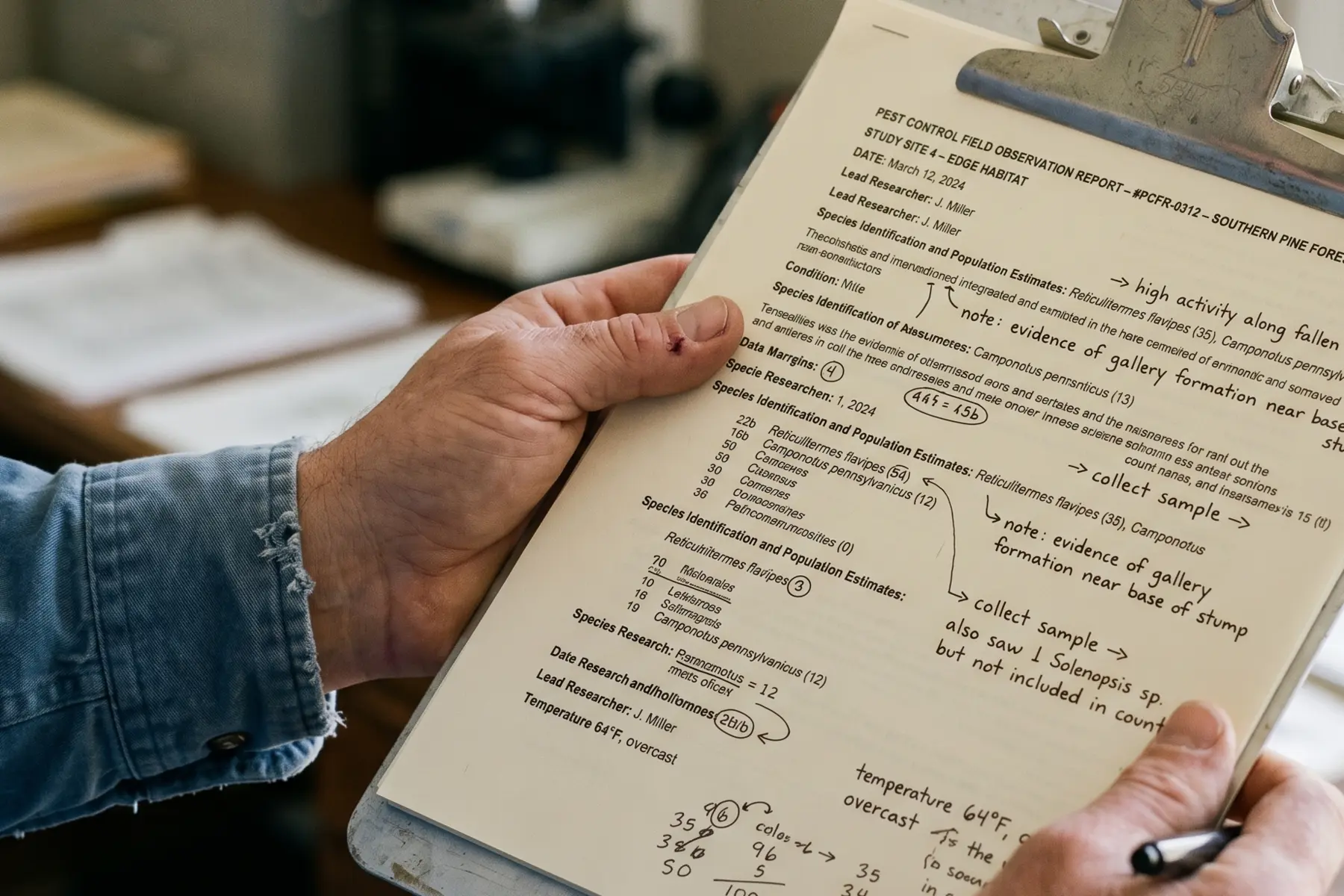
    Every quarterly visit produces a written report. The technician records: name, time on site, conditions observed by zone, treatment applied (with specific product and concentration when applicable), what to watch for before the next visit, and the projected next-visit window. The report is wedged in the door frame at the end of the visit, with a customer text confirming the visit is complete.

    Within 24 hours, a detailed PDF of the same report arrives by email. The format is closer to research field notes than to a service receipt — partly because that format produces auditable documentation for GreenPro recertification, and partly because the format makes the diagnostic reasoning legible to the customer. A vague treatment note (“treated perimeter,” “applied product”) doesn't help anyone audit anything later.

    About 12% of customers, mostly older homeowners, receive printed copies of every report by mail in addition to email. The reports are printed, signed, and mailed weekly from the office. The print run is small, the operational cost is real, and the relationship with that segment of customers depends on it.

    What's actually happening

    Why subscription lock-in became standard.

    In the early 2010s, the major pest control chains were rolled up by private equity, and the acquisitions converged on a single financial thesis: lifetime customer value rose dramatically when contracts auto-renewed for two years and cancellation cost the homeowner three hundred dollars. Profitable family-owned regional operators were acquired specifically because their contracts left customers free to leave. The missing lock-in was the upside the buyers paid for — the operations underneath were already working.

    The technician who shows up at your door is rarely the person who wrote the cancellation-fee structure. Auto-renewal terms and exit penalties get imposed at the corporate level, often by acquisition teams that never see the field. The outcome is predatory regardless of what the individual technician believes — the structure is what produces the outcome, and the structure is what stays.

    Marshlight runs the inverse structure. Quarterly visits are scheduled by season window. Treatment intensity is matched to observed pest pressure across the year. Pricing is published before any conversation. The term is month-to-month after the first quarter, with cancellation by phone call to the office. Technicians are paid salary — there is no commission incentive on the field side to recommend treatment that monitoring didn't justify.

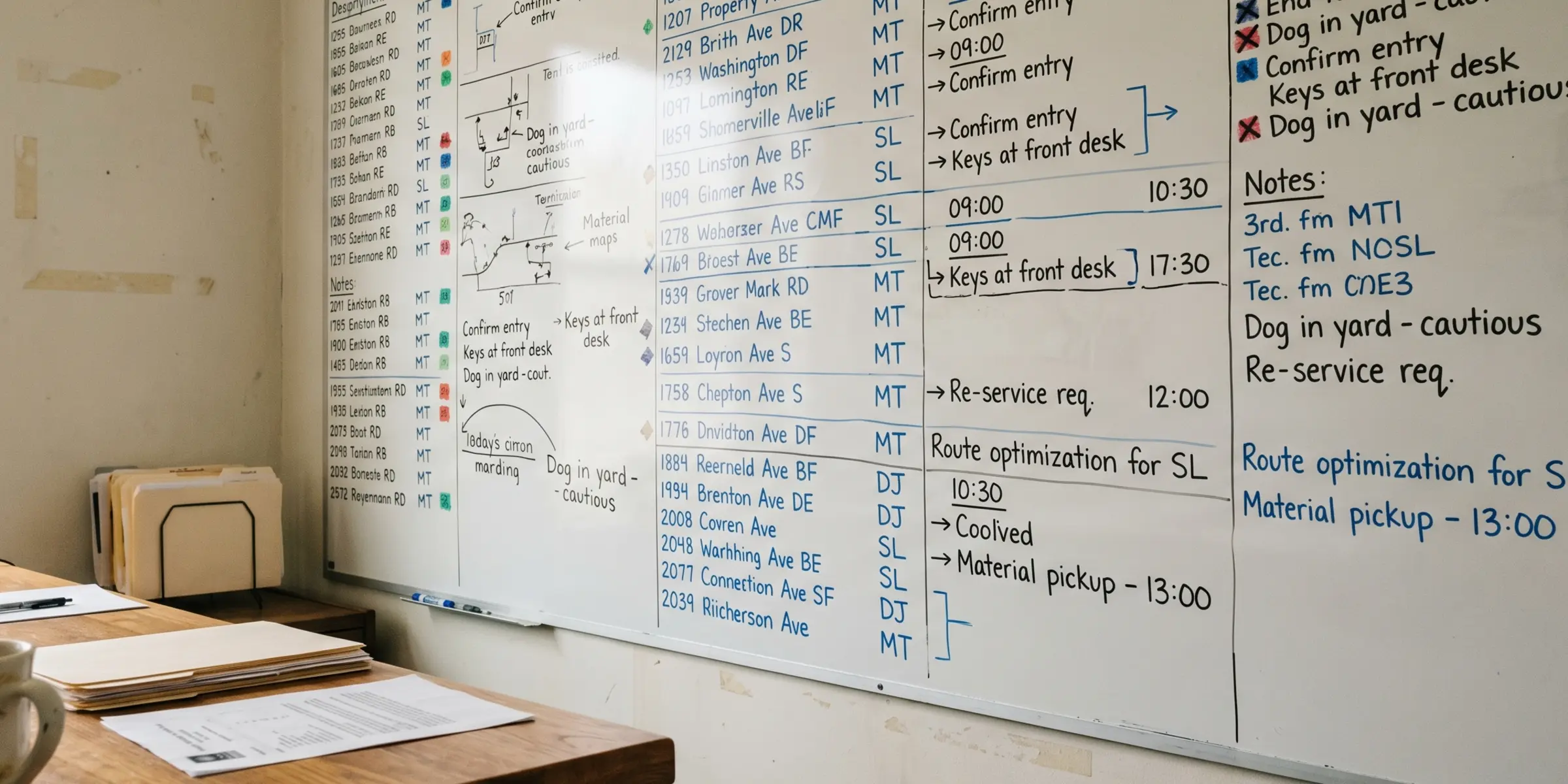
    Marshlight's office routing whiteboard, current week visible — handwritten technician routes, property addresses, weekly visit cadence
    Pricing

    Pricing, in writing, before you sign.

    Quarterly rates are flat. Properties under 4,000 square feet pay the same regardless of bedroom count, configuration, or service history. Properties at or above 4,000 square feet step to a single higher tier — that step covers the additional time and product, with no further increments by square footage above it.

    First inspection

    Property walk, written assessment, quote

    $0

    Quarterly visit (under 4,000 sq ft)

    $135

    Quarterly visit (4,000+ sq ft)

    $165

    Annual termite inspection (optional, separate)

    $185

    After the first quarter, service is month-to-month. Cancellation is a phone call to the office, processed without fees or holding periods. Re-treatments between scheduled visits are included if pests come back; the chain practice of charging for callbacks isn't part of the structure here.

    Service area

    Where we work, and where we don't.

    Where we work
    • Charleston (peninsula and west)
    • Mount Pleasant
    • James Island
    • West Ashley
    • Daniel Island
    • Sullivan's Island
    • Isle of Palms
    • Johns Island (north of Maybank Hwy)

    Same crew, same protocol across the footprint. The 8-city boundary expanded slowly between 2018 and 2022, geography by geography, as we could verify dispatch times.

    Where we don't
    • Folly Beach

      Seasonal-rental and second-home turnover makes recurring quarterly service unreliable. Customers aren't reliably at the property when scheduled, and the routing model breaks.

    • Summerville

      Different metro, different demand patterns. Better to refuse than promise quarterly service that can't be delivered consistently. Summerville inquiries get referred to a small operator we trust.

    • North of Highway 17 (Awendaw, McClellanville)

      Routing from the Folly Road dispatch makes quarterly visits inefficient by mid-afternoon, and rural Lowcountry pest pressure differs enough that we'd be working without enough local data.

    Technician's hands holding a Marshlight field report clipboard at a residential property, handwritten notes visible
    Process

    What a quarterly visit looks like.

    Visits are scheduled in 2-hour windows. The technician arrives, walks the property, identifies pest pressure by zone, and treats only what the monitoring data warrants. Most quarterly perimeter work doesn't require the customer to be present — standard procedure is to wedge the written field report in the door frame and text the customer when complete.

    A detailed PDF report follows by email within 24 hours: technician name, time on site, conditions observed, treatment applied (specific product if applicable), what to watch for before next visit, and the projected next-visit window. The reports read like research field notes because that's what the methodology requires — the documentation is auditable, including for GreenPro recertification.

    About 12% of customers, mostly older homeowners, receive printed copies of every report by mail in addition to email. The print run is small, the operational cost is real, and the relationship with that segment of customers depends on it.

    What customers say
    “We had Eastern subterranean termite activity behind the kitchen wall after years of paying Terminix for quarterly visits that never identified it. Marshlight’s first inspection found galleries within thirty minutes and walked us through the treatment plan before quoting. Twenty months in, no recurrence.”

    — Margaret D., West Ashley

    “Pest pressure changes seasonally. Service contracts shouldn't lock for two years.”

    — Caroline Holmes, Founder

    Schedule a free inspection

    Free inspection. Written assessment. Quarterly rate quoted before you sign.

    If the quarterly rate doesn't work for you, you've cost us an hour. That's a cost we absorb. Email is the primary channel for everything that follows; the form below routes to the office and gets a same-business-day response.

    First inspection is free. Same-business-day response.

    By submitting, you agree to be contacted by PRH Web via email or phone regarding your inquiry.

    marshlight

    Quarterly pest control for the Charleston Lowcountry. Free first inspection, transparent pricing, month-to-month after the first quarter.

    Service area

    Charleston
    Mount Pleasant
    James Island
    West Ashley
    Daniel Island
    Sullivan’s Island
    Isle of Palms
    Johns Island (north of Maybank Hwy)

    Hours & response

    office@marshlightpest.com
    (843) 555-0142
    Mon–Fri 8a–5p

    Email replied to within one business day. Phone reserved for genuine urgency.

    Credentials

    SC Pest Control #PCQO-3147
    QualityPro certified
    GreenPro certified
    Member, SC Pest Control Association
    M.S. Entomology · USC

    Marshlight Pest Control LLC · Founded 2018 · Charleston, SC.

    © 2026 Marshlight Pest Control LLC. All rights reserved.

    Demo site by PRH Web · Like this style? We can build one for your business.